
PROJECT
學習 (Learning) - VR
WORK
PROGRAMS
ABOUT
學習 (Learning) is a VR experiential essay portraying the socio-cultural impacts of autocratic education systems on communities and individuals, acting as a gateway for non-students to understand and resonate with this experience.
YEAR
2026

The Problem
53% of teens in the United States feel pressure to be exceptional and impressive through their achievements
61% of teenagers experience stress due to school-related pressures
Traditional discussions about academic stress often rely on statistics, or lectures making it difficult for people to experience or fully understand its emotional impact.
I wanted to explore how we might bridge the gap of understanding through an immersive VR experience.
Research Interviews:
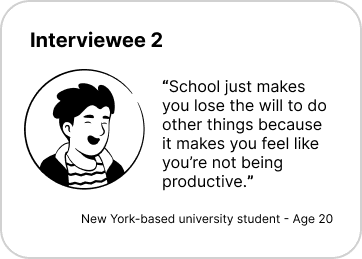
8 students (high school and college) were interviewed based on their experience with education to inform the narrative flow.


KEY Pain points:
Explaining the experience and details of chronic burnout to others is difficult
Pressure and large workload becomes normalized
Some challenges such as loss of individuality happen over long periods of time and are hard to identify
People might not notice systemic problems until they are personally affected
The Solution
A VR experience portraying a student’s experience through K-12 education, portraying the changing emotions as a student progresses through different stages of education. This creates an embodied experience for people unfamiliar to the experience to understand the problems students are facing.
KEY pillars:
Design Process
Narrative design
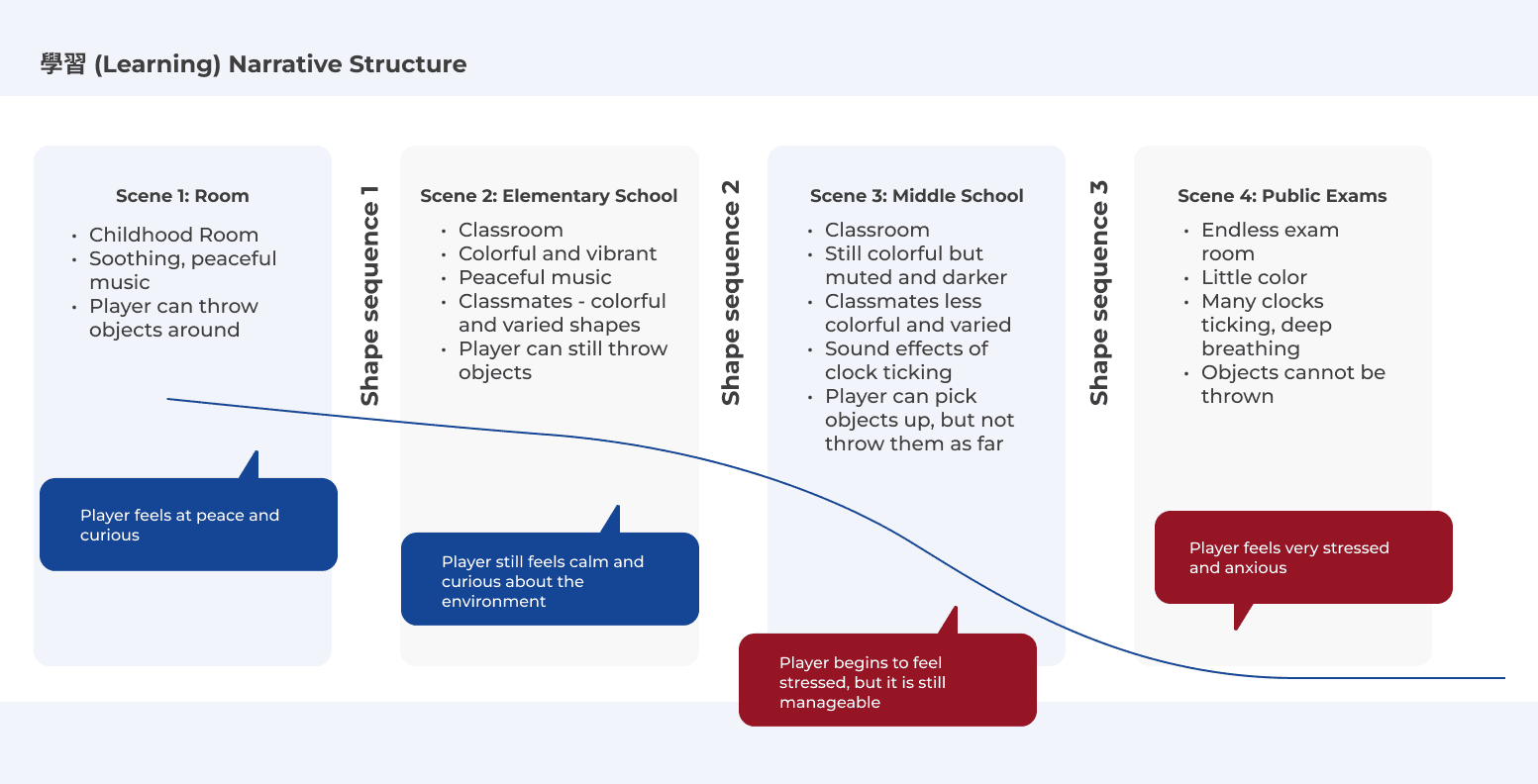
I wanted the user to feel calm in the beginning, then more and more stressed as the scenes progressed. This was done to emulate how the negative pressures of education creep up on its students, showing the deterioration of emotions over time rather than suddenly.

Visual Style Moodboard:
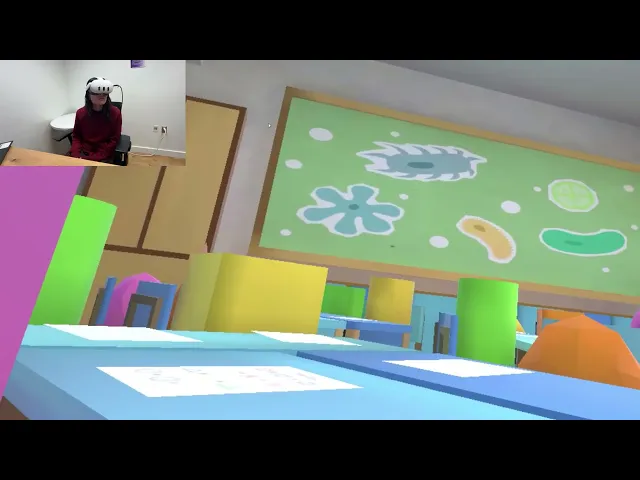
I went with a more abstract, low-poly style for the experience, inspired by other VR works like 'A Short History of the Gaze' by Molleindustria Games. The simpler style was more conducive to the time frame of the project and the optimization needed for smooth performance of the experience. The abstractness of the low-poly style was also more flexible to work with when it came to visual metaphors, which is why it was chosen for this project in the end.

User Testing
KEY Feedback:
Users felt that the sound effects were emotionally impactful, but thought that ambient audio or background music in the early scenes would further emphasize the change in tone
Most users did not pay attention to the "classmates" becoming more similar as the scenes progress to represent the loss of individuality
Users new to VR found the starting scene overwhelming due to the complexity of the environment and unfamiliarity to controls
Implementation of feedback:
Adding background music in beginning scenes to highlight change in tone
New sequence in between each scene to emphasize the "classmates" becoming more identical as time passes
Adding introductory scene in a personal room, creating a calm environment for new VR users to adapt to VR
Revised structure:
Final Outcome ↗


Key Challenges
Complexity vs Detail vs impact:
The time constraint was 1 month for end-to-end delivery; with this time limit, I had to strike a balance between abstraction and realism to make the experience emotionally impactful for the user yet still feasible for the time frame.
Programming in unity:
This was my first experience with C# for VR in Unity, and figuring out the game logic for the interactions I wanted was a steep learning curve. With the help of faculty and student mentors, I was able to work out how to program the VR interactions and what scripts were needed.
optimizing for VR:
Working in VR meant that there were additional considerations, such as onboarding people unfamiliar with VR, and avoiding certain technical details like rapid camera movement causing motion sickness. To really understand these technical boundaries, I had to do extensive firsthand research on other VR experiences, and also conduct multiple user tests to understand the needs of users new to VR.
Conclusion
This project was challenging yet a lot of fun to make, both creatively and technically. It helped me develop the skills needed to create compelling narratives through abstract storytelling in VR, and also taught me a lot about VR development and scripting in Unity. Exploring the features and limitations of VR was exciting, and I learned the importance of utilizing these unique affordances to create an emotionally impactful experience distinctive to VR.